# MMdnn
**Repository Path**: mirrors_qubvel/MMdnn
## Basic Information
- **Project Name**: MMdnn
- **Description**: MMdnn is a set of tools to help users inter-operate among different deep learning frameworks. E.g. model conversion and visualization. Convert models between Caffe, Keras, MXNet, Tensorflow, CNTK, PyTorch Onnx and CoreML.
- **Primary Language**: Unknown
- **License**: MIT
- **Default Branch**: master
- **Homepage**: None
- **GVP Project**: No
## Statistics
- **Stars**: 0
- **Forks**: 0
- **Created**: 2020-08-18
- **Last Updated**: 2026-03-21
## Categories & Tags
**Categories**: Uncategorized
**Tags**: None
## README
#  MMdnn
[](https://pypi.org/project/mmdnn/)
[](LICENSE)
[](https://travis-ci.org/Microsoft/MMdnn)
A comprehensive, cross-framework solution to convert, visualize and diagnose deep neural network models. The "MM" in MMdnn stands for model management and "dnn" is an acronym for the deep neural network.
Major features
- **Find model**
- We provide a [model collection](https://github.com/Microsoft/MMdnn/blob/master/mmdnn/models/README.md) to help you find some popular models.
- We provide a model visualizer to display the network architecture more intuitively.
- **Conversion**
- We implement a universal converter to convert DNN models between frameworks, which means you can train on one framework and deploy on another.
- **Retrain**
- In the converter, we can generate some training/inference code snippet to simplify the retrain/evaluate work.
- **Deployment**
- We provide some guidelines to help you deploy your models to another hardware platform.
- [Android](https://github.com/Microsoft/MMdnn/wiki/Deploy-your-TensorFlow-Lite-Model-in-Android)
- [Serving](https://github.com/Microsoft/MMdnn/wiki/Tensorflow-Serving-Via-Docker)
- We provide a guide to help you accelerate inference with TensorRT.
- [TensorRT](https://github.com/Microsoft/MMdnn/wiki/Using-TensorRT-to-Accelerate-Inference)
## Related Projects
[Microsoft Research Asia (MSRA)](https://www.microsoft.com/en-us/research/group/systems-research-group-asia/)
and Microsoft Search Technology Center Asia (STCA)
have released some projects to advance the state-of-art technology:
* [Open Platform for AI (OpenPAI)](https://github.com/Microsoft/pai): an open source platform that provides complete AI model training and resource management capabilities.
It is easy to extend and supports on-premise, cloud and hybrid environments in various scale.
* [Neural Network Intelligence (NNI)](https://github.com/Microsoft/nni): an open source AutoML toolkit for neural architecture search and hyper-parameter tuning.
We encourage researchers, developers and students to leverage such projects to boost their Deep Learning / AI productivity.
## Installation
### Install manually
You can get a stable version of MMdnn by
```bash
pip install mmdnn
```
And make sure to have [Python](https://www.python.org/) installed
or you can try the newest version by
```bash
pip install -U git+https://github.com/Microsoft/MMdnn.git@master
```
### Install with docker image
MMdnn provides a docker image, which packages MMdnn and Deep Learning frameworks that we support as well as other dependencies.
You can easily try the image with the following steps:
1. Install Docker Community Edition(CE)
[_Learn more about how to install docker_](https://github.com/Microsoft/MMdnn/blob/master/docs/InstallDockerCE.md)
1. Pull MMdnn docker image
```bash
docker pull mmdnn/mmdnn:cpu.small
```
1. Run image in an interactive mode
```bash
docker run -it mmdnn/mmdnn:cpu.small
```
## Features
### Model Conversion
Across the industry and academia, there are a number of existing frameworks available for developers and researchers to design a model, where each framework has its own network structure definition and saving model format. The gaps between frameworks impede the inter-operation of the models.
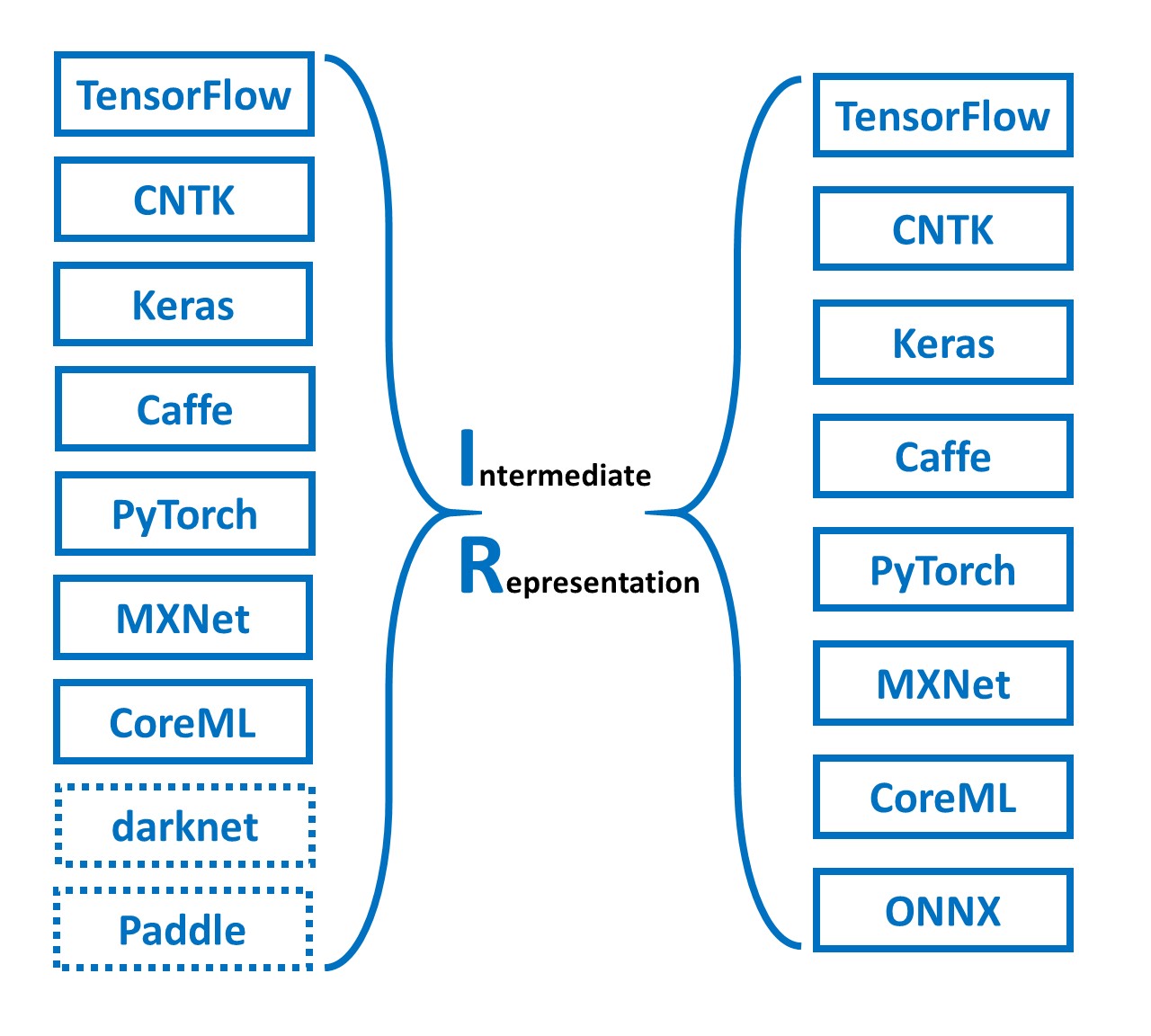 We provide a model converter to help developers convert models between frameworks through an intermediate representation format.
#### Support frameworks
> [Note] You can click the links to get detail README of each framework
- [Caffe](https://github.com/Microsoft/MMdnn/blob/master/mmdnn/conversion/caffe/README.md)
- [Microsoft Cognitive Toolkit (CNTK)](https://github.com/Microsoft/MMdnn/blob/master/mmdnn/conversion/cntk/README.md)
- [CoreML](https://github.com/Microsoft/MMdnn/blob/master/mmdnn/conversion/coreml/README.md)
- [Keras](https://github.com/Microsoft/MMdnn/blob/master/mmdnn/conversion/keras/README.md)
- [MXNet](https://github.com/Microsoft/MMdnn/blob/master/mmdnn/conversion/mxnet/README.md)
- [ONNX](https://github.com/Microsoft/MMdnn/blob/master/mmdnn/conversion/onnx/README.md) (Destination only)
- [PyTorch](https://github.com/Microsoft/MMdnn/blob/master/mmdnn/conversion/pytorch/README.md)
- [TensorFlow](https://github.com/Microsoft/MMdnn/blob/master/mmdnn/conversion/tensorflow/README.md) (Experimental) (We highly recommend you read the README of TensorFlow first)
- [DarkNet](https://github.com/Microsoft/MMdnn/blob/master/mmdnn/conversion/darknet/README.md) (Source only, Experiment)
#### Tested models
The model conversion between currently supported frameworks is tested on some **ImageNet** models.
Models | Caffe | Keras | TensorFlow | CNTK | MXNet | PyTorch | CoreML | ONNX
:-----:|:-----:|:-----:|:----------:|:----:|:-----:|:--------:|:------:|:-----:|
[VGG 19](https://arxiv.org/abs/1409.1556.pdf) | √ | √ | √ | √ | √ | √ | √ | √
[Inception V1](https://arxiv.org/abs/1409.4842v1) | √ | √ | √ | √ | √ | √ | √ | √
[Inception V3](https://arxiv.org/abs/1512.00567) | √ | √ | √ | √ | √ | √ | √ | √
[Inception V4](https://arxiv.org/abs/1512.00567) | √ | √ | √ | o | √ | √ | √ | √
[ResNet V1](https://arxiv.org/abs/1512.03385) | × | √ | √ | o | √ | √ | √ | √
[ResNet V2](https://arxiv.org/abs/1603.05027) | √ | √ | √ | √ | √ | √ | √ | √
[MobileNet V1](https://arxiv.org/pdf/1704.04861.pdf) | × | √ | √ | o | √ | √ | √ | √ | √
[MobileNet V2](https://arxiv.org/pdf/1704.04861.pdf) | × | √ | √ | o | √ | √ | √ | √ | √
[Xception](https://arxiv.org/pdf/1610.02357.pdf) | √ | √ | √ | o | × | √ | √ | √ | √
[SqueezeNet](https://arxiv.org/pdf/1602.07360) | √ | √ | √ | √ | √ | √ | √ | √ | √
[DenseNet](https://arxiv.org/abs/1608.06993) | √ | √ | √ | √ | √ | √ | √ | √
[NASNet](https://arxiv.org/abs/1707.07012) | x | √ | √ | o | √ | √ | √ | x
[ResNext](https://arxiv.org/abs/1611.05431) | √ | √ | √ | √ | √ | √ | √ | √ | √ | √
[voc FCN](https://people.eecs.berkeley.edu/~jonlong/long_shelhamer_fcn.pdf) | | | √ | √ | |
Yolo3 | | √ | | √ |
#### Usage
One command to achieve the conversion. Using TensorFlow **ResNet V2 152** to PyTorch as our example.
```bash
$ mmdownload -f tensorflow -n resnet_v2_152 -o ./
$ mmconvert -sf tensorflow -in imagenet_resnet_v2_152.ckpt.meta -iw imagenet_resnet_v2_152.ckpt --dstNodeName MMdnn_Output -df pytorch -om tf_resnet_to_pth.pth
```
Done.
#### On-going frameworks
- Torch7 (help wanted)
- Chainer (help wanted)
#### On-going Models
- Face Detection
- Semantic Segmentation
- Image Style Transfer
- Object Detection
- RNN
---
### Model Visualization
You can use the [MMdnn model visualizer](http://vis.mmdnn.com/) and submit your IR json file to visualize your model. In order to run the commands below, you will need to install [requests](https://anaconda.org/anaconda/requests), [keras](https://anaconda.org/anaconda/keras), and [TensorFlow](https://anaconda.org/anaconda/tensorflow) using your favorite package manager.
Use the [Keras "inception_v3" model](https://github.com/fchollet/deep-learning-models) as an example again.
1. Download the pre-trained models
```bash
$ mmdownload -f keras -n inception_v3
```
2. Convert the pre-trained model files into an intermediate representation
```bash
$ mmtoir -f keras -w imagenet_inception_v3.h5 -o keras_inception_v3
```
3. Open the [MMdnn model visualizer](http://mmdnn.eastasia.cloudapp.azure.com:8080/) and choose file *keras_inception_v3.json*

---
## Examples
### Official Tutorial
- [Keras "inception V3" to CNTK](https://github.com/Microsoft/MMdnn/blob/master/docs/keras2cntk.md) and [related issue](https://github.com/Microsoft/MMdnn/issues/19)
- [TensorFlow slim model "ResNet V2 152" to PyTorch](https://github.com/Microsoft/MMdnn/blob/master/docs/tf2pytorch.md)
- [Mxnet model "LResNet50E-IR" to TensorFlow](https://github.com/Microsoft/MMdnn/issues/85) and [related issue](https://github.com/Microsoft/MMdnn/issues/135)
### Users' Examples
- [MXNet "ResNet-152-11k" to PyTorch](https://github.com/Microsoft/MMdnn/issues/6)
- [MXNet "ResNeXt" to Keras](https://github.com/Microsoft/MMdnn/issues/58)
- [TensorFlow "ResNet-101" to PyTorch](https://github.com/Microsoft/MMdnn/issues/22)
- [TensorFlow "mnist mlp model" to CNTK](https://github.com/Microsoft/MMdnn/issues/11)
- [TensorFlow "Inception_v3" to MXNet](https://github.com/Microsoft/MMdnn/issues/30)
- [Caffe "voc-fcn" to TensorFlow](https://github.com/Microsoft/MMdnn/issues/29)
- [Caffe "AlexNet" to TensorFlow](https://github.com/Microsoft/MMdnn/issues/10)
- [Caffe "inception_v4" to TensorFlow](https://github.com/Microsoft/MMdnn/issues/26)
- [Caffe "VGG16_SOD" to TensorFlow](https://github.com/Microsoft/MMdnn/issues/27)
- [Caffe "SqueezeNet v1.1" to CNTK](https://github.com/Microsoft/MMdnn/issues/48)
---
## Contributing
### Intermediate Representation
The intermediate representation stores the **network architecture** in **protobuf binary** and **pre-trained weights** in **NumPy** native format.
> [Note!] Currently the IR weights data is in NHWC (channel last) format.
Details are in [ops.txt](https://github.com/Microsoft/MMdnn/blob/master/mmdnn/conversion/common/IR/ops.pbtxt) and [graph.proto](https://github.com/Microsoft/MMdnn/blob/master/mmdnn/conversion/common/IR/graph.proto). New operators and any comments are welcome.
### Frameworks
We are working on other frameworks conversion and visualization, such as PyTorch, CoreML and so on. We're investigating more RNN related operators. Any contributions and suggestions are welcome! Details in [Contribution Guideline](https://github.com/Microsoft/MMdnn/wiki/Contribution-Guideline).
### License
Most contributions require you to agree to a Contributor License Agreement (CLA) declaring that you have the right to and actually do, grant us
the rights to use your contribution. For details, visit https://cla.microsoft.com.
When you submit a pull request, a CLA-bot will automatically determine whether you need to provide
a CLA and decorate the PR appropriately (e.g., label, comment). Simply follow the instructions
provided by the bot. You will only need to do this once across all repos using our CLA.
This project has adopted the [Microsoft Open Source Code of Conduct](https://opensource.microsoft.com/codeofconduct/).
For more information see the [Code of Conduct FAQ](https://opensource.microsoft.com/codeofconduct/faq/) or
contact [opencode@microsoft.com](mailto:opencode@microsoft.com) with any additional questions or comments.
## Authors
Cheng CHEN (Microsoft Research Asia): Project Manager; Caffe, CNTK, CoreML Emitter, Keras, MXNet, TensorFlow
Jiahao YAO (Peking University): CoreML, MXNet Emitter, PyTorch Parser; HomePage
Ru ZHANG (Chinese Academy of Sciences): CoreML Emitter, DarkNet Parser, Keras, TensorFlow frozen graph Parser; Yolo and SSD models; Tests
Yuhao ZHOU (Shanghai Jiao Tong University): MXNet
Tingting QIN (Microsoft Research Asia): Caffe Emitter
Tong ZHAN (Microsoft): ONNX Emitter
Qianwen WANG (Hong Kong University of Science and Technology): Visualization
## Acknowledgements
Thanks to [Saumitro Dasgupta](https://github.com/ethereon), the initial code of *caffe -> IR converting* is references to his project [caffe-tensorflow](https://github.com/ethereon/caffe-tensorflow).
We provide a model converter to help developers convert models between frameworks through an intermediate representation format.
#### Support frameworks
> [Note] You can click the links to get detail README of each framework
- [Caffe](https://github.com/Microsoft/MMdnn/blob/master/mmdnn/conversion/caffe/README.md)
- [Microsoft Cognitive Toolkit (CNTK)](https://github.com/Microsoft/MMdnn/blob/master/mmdnn/conversion/cntk/README.md)
- [CoreML](https://github.com/Microsoft/MMdnn/blob/master/mmdnn/conversion/coreml/README.md)
- [Keras](https://github.com/Microsoft/MMdnn/blob/master/mmdnn/conversion/keras/README.md)
- [MXNet](https://github.com/Microsoft/MMdnn/blob/master/mmdnn/conversion/mxnet/README.md)
- [ONNX](https://github.com/Microsoft/MMdnn/blob/master/mmdnn/conversion/onnx/README.md) (Destination only)
- [PyTorch](https://github.com/Microsoft/MMdnn/blob/master/mmdnn/conversion/pytorch/README.md)
- [TensorFlow](https://github.com/Microsoft/MMdnn/blob/master/mmdnn/conversion/tensorflow/README.md) (Experimental) (We highly recommend you read the README of TensorFlow first)
- [DarkNet](https://github.com/Microsoft/MMdnn/blob/master/mmdnn/conversion/darknet/README.md) (Source only, Experiment)
#### Tested models
The model conversion between currently supported frameworks is tested on some **ImageNet** models.
Models | Caffe | Keras | TensorFlow | CNTK | MXNet | PyTorch | CoreML | ONNX
:-----:|:-----:|:-----:|:----------:|:----:|:-----:|:--------:|:------:|:-----:|
[VGG 19](https://arxiv.org/abs/1409.1556.pdf) | √ | √ | √ | √ | √ | √ | √ | √
[Inception V1](https://arxiv.org/abs/1409.4842v1) | √ | √ | √ | √ | √ | √ | √ | √
[Inception V3](https://arxiv.org/abs/1512.00567) | √ | √ | √ | √ | √ | √ | √ | √
[Inception V4](https://arxiv.org/abs/1512.00567) | √ | √ | √ | o | √ | √ | √ | √
[ResNet V1](https://arxiv.org/abs/1512.03385) | × | √ | √ | o | √ | √ | √ | √
[ResNet V2](https://arxiv.org/abs/1603.05027) | √ | √ | √ | √ | √ | √ | √ | √
[MobileNet V1](https://arxiv.org/pdf/1704.04861.pdf) | × | √ | √ | o | √ | √ | √ | √ | √
[MobileNet V2](https://arxiv.org/pdf/1704.04861.pdf) | × | √ | √ | o | √ | √ | √ | √ | √
[Xception](https://arxiv.org/pdf/1610.02357.pdf) | √ | √ | √ | o | × | √ | √ | √ | √
[SqueezeNet](https://arxiv.org/pdf/1602.07360) | √ | √ | √ | √ | √ | √ | √ | √ | √
[DenseNet](https://arxiv.org/abs/1608.06993) | √ | √ | √ | √ | √ | √ | √ | √
[NASNet](https://arxiv.org/abs/1707.07012) | x | √ | √ | o | √ | √ | √ | x
[ResNext](https://arxiv.org/abs/1611.05431) | √ | √ | √ | √ | √ | √ | √ | √ | √ | √
[voc FCN](https://people.eecs.berkeley.edu/~jonlong/long_shelhamer_fcn.pdf) | | | √ | √ | |
Yolo3 | | √ | | √ |
#### Usage
One command to achieve the conversion. Using TensorFlow **ResNet V2 152** to PyTorch as our example.
```bash
$ mmdownload -f tensorflow -n resnet_v2_152 -o ./
$ mmconvert -sf tensorflow -in imagenet_resnet_v2_152.ckpt.meta -iw imagenet_resnet_v2_152.ckpt --dstNodeName MMdnn_Output -df pytorch -om tf_resnet_to_pth.pth
```
Done.
#### On-going frameworks
- Torch7 (help wanted)
- Chainer (help wanted)
#### On-going Models
- Face Detection
- Semantic Segmentation
- Image Style Transfer
- Object Detection
- RNN
---
### Model Visualization
You can use the [MMdnn model visualizer](http://vis.mmdnn.com/) and submit your IR json file to visualize your model. In order to run the commands below, you will need to install [requests](https://anaconda.org/anaconda/requests), [keras](https://anaconda.org/anaconda/keras), and [TensorFlow](https://anaconda.org/anaconda/tensorflow) using your favorite package manager.
Use the [Keras "inception_v3" model](https://github.com/fchollet/deep-learning-models) as an example again.
1. Download the pre-trained models
```bash
$ mmdownload -f keras -n inception_v3
```
2. Convert the pre-trained model files into an intermediate representation
```bash
$ mmtoir -f keras -w imagenet_inception_v3.h5 -o keras_inception_v3
```
3. Open the [MMdnn model visualizer](http://mmdnn.eastasia.cloudapp.azure.com:8080/) and choose file *keras_inception_v3.json*

---
## Examples
### Official Tutorial
- [Keras "inception V3" to CNTK](https://github.com/Microsoft/MMdnn/blob/master/docs/keras2cntk.md) and [related issue](https://github.com/Microsoft/MMdnn/issues/19)
- [TensorFlow slim model "ResNet V2 152" to PyTorch](https://github.com/Microsoft/MMdnn/blob/master/docs/tf2pytorch.md)
- [Mxnet model "LResNet50E-IR" to TensorFlow](https://github.com/Microsoft/MMdnn/issues/85) and [related issue](https://github.com/Microsoft/MMdnn/issues/135)
### Users' Examples
- [MXNet "ResNet-152-11k" to PyTorch](https://github.com/Microsoft/MMdnn/issues/6)
- [MXNet "ResNeXt" to Keras](https://github.com/Microsoft/MMdnn/issues/58)
- [TensorFlow "ResNet-101" to PyTorch](https://github.com/Microsoft/MMdnn/issues/22)
- [TensorFlow "mnist mlp model" to CNTK](https://github.com/Microsoft/MMdnn/issues/11)
- [TensorFlow "Inception_v3" to MXNet](https://github.com/Microsoft/MMdnn/issues/30)
- [Caffe "voc-fcn" to TensorFlow](https://github.com/Microsoft/MMdnn/issues/29)
- [Caffe "AlexNet" to TensorFlow](https://github.com/Microsoft/MMdnn/issues/10)
- [Caffe "inception_v4" to TensorFlow](https://github.com/Microsoft/MMdnn/issues/26)
- [Caffe "VGG16_SOD" to TensorFlow](https://github.com/Microsoft/MMdnn/issues/27)
- [Caffe "SqueezeNet v1.1" to CNTK](https://github.com/Microsoft/MMdnn/issues/48)
---
## Contributing
### Intermediate Representation
The intermediate representation stores the **network architecture** in **protobuf binary** and **pre-trained weights** in **NumPy** native format.
> [Note!] Currently the IR weights data is in NHWC (channel last) format.
Details are in [ops.txt](https://github.com/Microsoft/MMdnn/blob/master/mmdnn/conversion/common/IR/ops.pbtxt) and [graph.proto](https://github.com/Microsoft/MMdnn/blob/master/mmdnn/conversion/common/IR/graph.proto). New operators and any comments are welcome.
### Frameworks
We are working on other frameworks conversion and visualization, such as PyTorch, CoreML and so on. We're investigating more RNN related operators. Any contributions and suggestions are welcome! Details in [Contribution Guideline](https://github.com/Microsoft/MMdnn/wiki/Contribution-Guideline).
### License
Most contributions require you to agree to a Contributor License Agreement (CLA) declaring that you have the right to and actually do, grant us
the rights to use your contribution. For details, visit https://cla.microsoft.com.
When you submit a pull request, a CLA-bot will automatically determine whether you need to provide
a CLA and decorate the PR appropriately (e.g., label, comment). Simply follow the instructions
provided by the bot. You will only need to do this once across all repos using our CLA.
This project has adopted the [Microsoft Open Source Code of Conduct](https://opensource.microsoft.com/codeofconduct/).
For more information see the [Code of Conduct FAQ](https://opensource.microsoft.com/codeofconduct/faq/) or
contact [opencode@microsoft.com](mailto:opencode@microsoft.com) with any additional questions or comments.
## Authors
Cheng CHEN (Microsoft Research Asia): Project Manager; Caffe, CNTK, CoreML Emitter, Keras, MXNet, TensorFlow
Jiahao YAO (Peking University): CoreML, MXNet Emitter, PyTorch Parser; HomePage
Ru ZHANG (Chinese Academy of Sciences): CoreML Emitter, DarkNet Parser, Keras, TensorFlow frozen graph Parser; Yolo and SSD models; Tests
Yuhao ZHOU (Shanghai Jiao Tong University): MXNet
Tingting QIN (Microsoft Research Asia): Caffe Emitter
Tong ZHAN (Microsoft): ONNX Emitter
Qianwen WANG (Hong Kong University of Science and Technology): Visualization
## Acknowledgements
Thanks to [Saumitro Dasgupta](https://github.com/ethereon), the initial code of *caffe -> IR converting* is references to his project [caffe-tensorflow](https://github.com/ethereon/caffe-tensorflow).