# libs
**Repository Path**: mirrors_falcosecurity/libs
## Basic Information
- **Project Name**: libs
- **Description**: libsinsp, libscap, the kernel module driver, and the eBPF driver sources
- **Primary Language**: Unknown
- **License**: Apache-2.0
- **Default Branch**: master
- **Homepage**: None
- **GVP Project**: No
## Statistics
- **Stars**: 0
- **Forks**: 0
- **Created**: 2021-10-22
- **Last Updated**: 2026-03-30
## Categories & Tags
**Categories**: Uncategorized
**Tags**: None
## README
# falcosecurity/libs
[](https://github.com/falcosecurity/evolution/blob/main/REPOSITORIES.md#core-scope) [](https://github.com/falcosecurity/evolution/blob/main/REPOSITORIES.md#stable) [](./COPYING)
[](https://github.com/falcosecurity/libs/actions/workflows/ci.yml)
[](#drivers-officially-supported-architectures)
[](https://github.com/falcosecurity/libs/actions/workflows/latest-kernel.yml)
[](https://falcosecurity.github.io/libs/)
This repository contains **libsinsp**, **libscap**, the **kernel module** and the **modern eBPF probe** sources.
These components are at the foundation of [Falco](https://github.com/falcosecurity/falco) and other projects that work with the same kind of data.
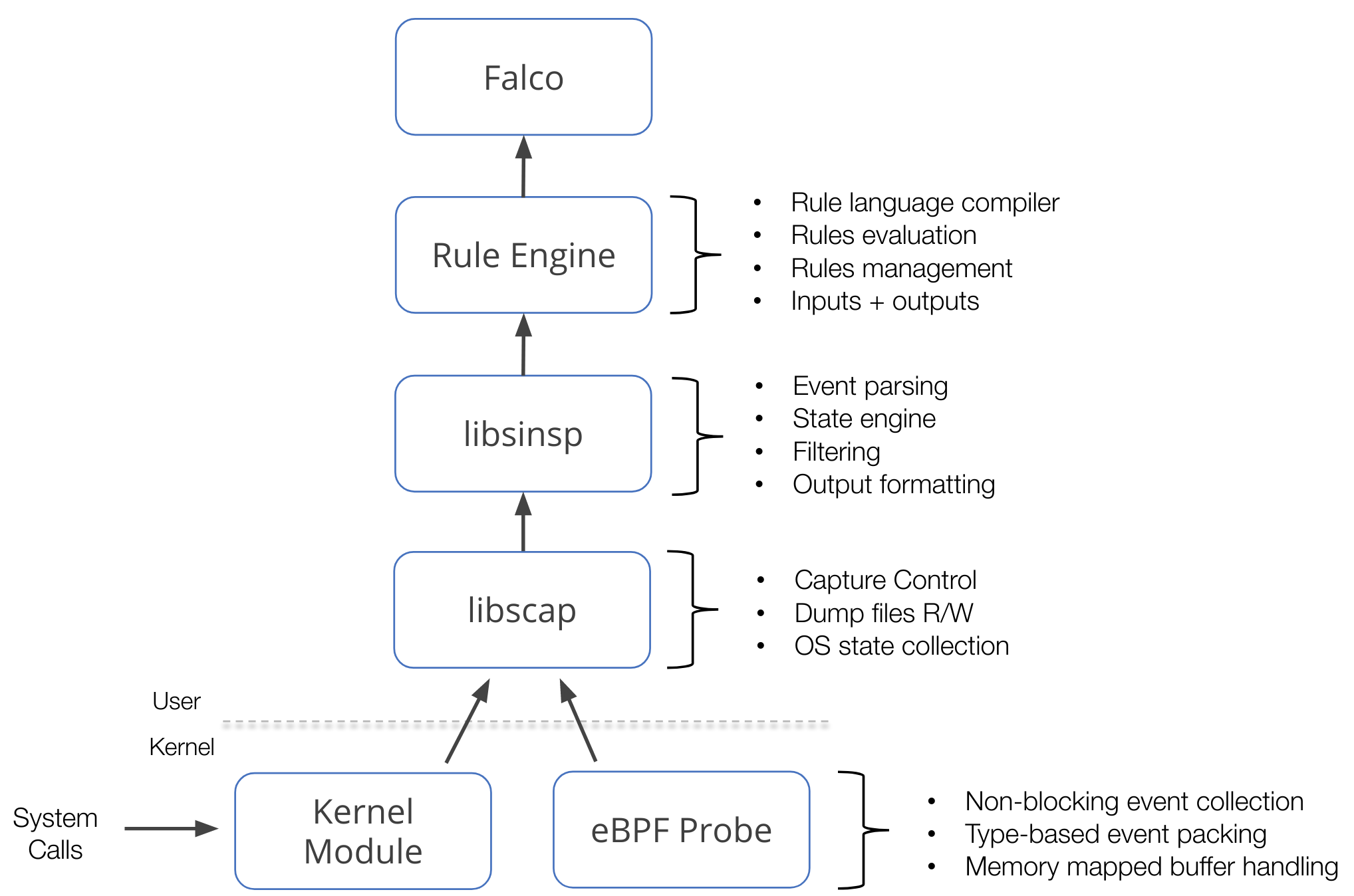
This component stack mainly operates on syscall events. We monitor syscalls using either a kernel module or an eBPF probe, which we call *drivers*. On top of the drivers, `libscap` manages the data capture process, while `libsinsp` enriches the data, and provides a rich set of API to consume the data. Furthermore, these two libraries also implement a [plugin](https://github.com/falcosecurity/plugins) framework that extends this stack to potentially any other data sources. For further details, please refer to Falco's [official documentation](https://falco.org/docs/).
An image is worth a thousand words, they say:
 ## Project Layout
* [_driver/_](./driver) contains kernel module and modern eBPF probe source code,
so-called **drivers**.
* [_userspace/_](./userspace) contains libscap and libsinsp libraries code.
* **libscap** (aka lib for *System CAPture*) is the userspace library
that directly communicates with the drivers, reading syscall events from
the ring buffer (where drivers place them), and forwarding them
up to libsinsp. Moreover, libscap implements OS state collection and
supports reading/writing to scap files.
* **libsinsp** (aka lib for *System INSPection*) receives events from
libscap and enriches them with machine state: moreover, it performs
events filtering with rule evaluation through its internal rule engine.
Finally, it manages outputs.
* [_proposals/_](./proposals) unexpectedly contains the list of proposals.
* [_cmake/modules/_](./cmake/modules) contains modules to build
external dependencies, plus the libscap and libsinsp ones; consumers
(like Falco) use those modules to build the libs in their projects.
## Drivers Officially Supported Architectures
Our drivers officially support the following architectures:
| | Kernel module | Modern eBPF probe | Status |
| ----------- |----------------------------------------------------------------------------------------------| ----------------- | ------ |
| **x86_64** | >= 3.10 | >= 5.8 | _STABLE_ |
| **aarch64** | >= [3.16](https://github.com/torvalds/linux/commit/055b1212d141f1f398fca548f8147787c0b6253f) | >= 5.8 | _STABLE_ |
| **s390x** | >= 3.10 | >= 5.8 | _EXPERIMENTAL_ |
| **riscv64** | >= [5.0](https://github.com/torvalds/linux/commit/5aeb1b36cedd3a1dfdbfe368629fed52dee34103) |N/A | _EXPERIMENTAL_ |
| **ppc64le** | >= 3.10 | >= 5.8 | _STABLE_ |
To access up-to-date status reports on Falco drivers kernel testing, please visit this [page](https://falcosecurity.github.io/libs/). It provides a list of supported syscalls as well as the [report](https://falcosecurity.github.io/libs/report/).
> __NOTE:__ while we strive to achieve maximum compatibility, we cannot assure that drivers correctly build against a new kernel version minutes after it gets released, since we might need to make some adjustments.
> To get properly notified whenever drivers stop building, we have a [CI workflow](.github/workflows/latest-kernel.yml) that tests the build against the [latest mainline kernel](https://www.kernel.org/) (RC too!)
> __NOTE:__ _STABLE_ state means that we have CI covering drivers tests on the architecture. _EXPERIMENTAL_ means that we are not able to run any CI test against it.
## Versioning
## Project Layout
* [_driver/_](./driver) contains kernel module and modern eBPF probe source code,
so-called **drivers**.
* [_userspace/_](./userspace) contains libscap and libsinsp libraries code.
* **libscap** (aka lib for *System CAPture*) is the userspace library
that directly communicates with the drivers, reading syscall events from
the ring buffer (where drivers place them), and forwarding them
up to libsinsp. Moreover, libscap implements OS state collection and
supports reading/writing to scap files.
* **libsinsp** (aka lib for *System INSPection*) receives events from
libscap and enriches them with machine state: moreover, it performs
events filtering with rule evaluation through its internal rule engine.
Finally, it manages outputs.
* [_proposals/_](./proposals) unexpectedly contains the list of proposals.
* [_cmake/modules/_](./cmake/modules) contains modules to build
external dependencies, plus the libscap and libsinsp ones; consumers
(like Falco) use those modules to build the libs in their projects.
## Drivers Officially Supported Architectures
Our drivers officially support the following architectures:
| | Kernel module | Modern eBPF probe | Status |
| ----------- |----------------------------------------------------------------------------------------------| ----------------- | ------ |
| **x86_64** | >= 3.10 | >= 5.8 | _STABLE_ |
| **aarch64** | >= [3.16](https://github.com/torvalds/linux/commit/055b1212d141f1f398fca548f8147787c0b6253f) | >= 5.8 | _STABLE_ |
| **s390x** | >= 3.10 | >= 5.8 | _EXPERIMENTAL_ |
| **riscv64** | >= [5.0](https://github.com/torvalds/linux/commit/5aeb1b36cedd3a1dfdbfe368629fed52dee34103) |N/A | _EXPERIMENTAL_ |
| **ppc64le** | >= 3.10 | >= 5.8 | _STABLE_ |
To access up-to-date status reports on Falco drivers kernel testing, please visit this [page](https://falcosecurity.github.io/libs/). It provides a list of supported syscalls as well as the [report](https://falcosecurity.github.io/libs/report/).
> __NOTE:__ while we strive to achieve maximum compatibility, we cannot assure that drivers correctly build against a new kernel version minutes after it gets released, since we might need to make some adjustments.
> To get properly notified whenever drivers stop building, we have a [CI workflow](.github/workflows/latest-kernel.yml) that tests the build against the [latest mainline kernel](https://www.kernel.org/) (RC too!)
> __NOTE:__ _STABLE_ state means that we have CI covering drivers tests on the architecture. _EXPERIMENTAL_ means that we are not able to run any CI test against it.
## Versioning
Expand Versioning Details
This project utilizes two different numbering series for the _libs_ and _drivers_ components, both in accordance with [Semantic Versioning 2.0.0](https://semver.org/). In particular, the _drivers_ component versions include a `driver` suffix in the [build metadata](https://semver.org/#spec-item-10) part of the SemVer string (ie. `5.1.0+driver`) to differentiate them from the _libs_ versions (ie. `0.12.0`). Further details about how we manage the versioning of these components can be found in our [release process documentation](./release.md).
When building this project from a Git working directory, the build system (see [CMakeLists.txt](./CMakeLists.txt)) will automatically determine the correct version for all components.
For [officially released builds](https://github.com/falcosecurity/libs/releases), the corresponding Git tag will be used as the version.
For development versions, the following schema is applied:
`..-+[-driver]`
Where:
- `..` represents the next version number, reflecting either a patch for release branches or a minor version for development branches.
- `` is the number of commits ahead from either:
- the latest tag on the branch, for release branches; or
- the closest common ancestor with the branch holding the latest tagged version, for development branches.
- `` refers to the first 7 digits of the commit hash.
- `[-driver]` is an optional suffix used specifically for _driver_ versions.
For example, `0.13.0-2+abcdef0` means that the current _HEAD_ (_G_, commit hash `abcdef0`) is the second commit ahead of the common ancestor (_E_) with the release branch that holds the tag for `0.12.0` (_C_):
```
A---B---C (tag: 0.12.0, branch: release/0.12.x)
/
D---E---F---G (HEAD -> abcdef0)
```
This scheme ensures the correct [precedence](https://semver.org/#spec-item-11) when comparing build version numbers, regardless of whether they are released or development builds.
If you are building this project outside of a Git working directory, or if you want to override the version numbers, you must correctly set the appropriate `cmake` variables. For example, use `-DFALCOSECURITY_LIBS_VERSION=x.y.z -DDRIVER_VERSION=a.b.c+driver`.
## Build
Expand Build Instructions
For your convenience, we have included the instructions for building the `libs` modules here, in addition to the information available in Falco's [official documentation](https://falco.org/docs/install-operate/source/). These instructions are designed for building and testing `libs` on your own Linux development machine. However, if you intend to adopt CI or build within containers, there are additional considerations to take into account. The official [website]((https://falco.org/docs/install-operate/source/)) continually extends its guidance in this respect.
The project utilizes the `cmake` build system, and the key `make` targets are as follows:
* `driver` -> build the kmod
* `scap` -> build libscap (`modern_ebpf` driver will be bundled into `scap` if enabled)
* `sinsp` -> build libsinsp (depends upon `scap` target)
* `scap-open` -> build a small example binary for `libscap` to test the drivers (dependent on `scap`)
* `sinsp-example` -> build a small example binary for `libsinsp` to test the drivers and/or `libsinsp` functionality (dependent on `scap` and `sinsp`)
You can refer to the main [CMakeLists.txt](CMakeLists.txt) file to explore the available targets and flags.
To start, first create and move inside `build/` folder:
```bash
mkdir build && cd build
```
### Build userspace using bundled deps
The easiest way to build the project is to use `BUNDLED_DEPS` option (enabled by default),
meaning that most of the dependencies will be fetched and compiled during the process:
```bash
cmake -DUSE_BUNDLED_DEPS=ON ../;
make sinsp
```
> __NOTE:__ Take a break as this will take quite a bit of time (around 15 mins, dependent on the hardware).
### Build userspace using system deps
To build using the system deps instead, first, make sure to have all the needed packages installed. Refer to Falco's [official documentation](https://falco.org/docs/install-operate/source/).
```bash
cmake -DUSE_BUNDLED_DEPS=OFF ../;
make sinsp
```
> __NOTE:__ Using system libraries is useful to cut compile times down, as this way it will only build libs, and not all deps. On the other hand, system deps version may have an impact, and we cannot guarantee everything goes smoothly while using them.
### Build driver - kmod
To build the kmod driver, you need your kernel headers installed. Check out Falco's [official documentation](https://falco.org/docs/install-operate/source/).
```bash
make driver
# Verify the kmod binary object file was created, uses `.ko` extension.
ls -l driver/src/scap.ko;
```
### Build driver - modern eBPF probe
To build the modern eBPF probe, further prerequisites are necessary:
* A recent `clang` version (>=`12`).
* A recent `bpftool` version, typing `bpftool gen` you should see at least these features:
```
Usage: bpftool gen object OUTPUT_FILE INPUT_FILE [INPUT_FILE...] <---
bpftool gen skeleton FILE [name OBJECT_NAME] <---
bpftool gen help
```
If you want to use the `bpftool` mirror repo, version [`6.7`](https://github.com/libbpf/bpftool/releases/tag/v6.7.0) should be enough.
If you want to compile it directly from the kernel tree you should pick at least the `5.13` tag.
* BTF exposed by your kernel, you can check it through `ls /sys/kernel/btf/vmlinux`. You should see this line:
```
/sys/kernel/btf/vmlinux
```
* A kernel version >=`5.8`.
> __NOTE:__ These are not the requirements to use the modern BPF probe, but rather for building it from source.
The modern eBPF driver build process doesn't require kernel headers, and it isn't tied to your kernel release. This is enabled by the CO-RE (Compile Once - Run Everywhere) feature of the modern eBPF driver.
CO-RE allows the driver to work on kernels with backported BTF (BPF Type Format) support or kernel versions >= 5.8. The way the driver interprets kernel data structures without direct knowledge of the running kernel is not magic — it leverages predefined type information and BTF-based relocations. We maintain a [vmlinux.h](driver/modern_bpf/definitions/vmlinux.h) file containing essential kernel data structure definitions, allowing the eBPF program to reference fields dynamically. Additionally, for cases where macros or functions from system headers are required, we redefine them in [struct_flavors.h](driver/modern_bpf/definitions/struct_flavors.h). Combined with CO-RE (Compile Once, Run Everywhere), this enables the driver to remain portable across different kernel versions.
The modern eBPF driver build process produces an eBPF header skeleton file using `bpftool`. The skeleton file is a C header file that embeds the compiled eBPF program as bytecode.
```bash
cmake \
-DUSE_BUNDLED_DEPS=ON \
-DBUILD_LIBSCAP_MODERN_BPF=ON ../;
make ProbeSkeleton
# Verify the modern eBPF bytecode / final composed header file including all `.o` modern_ebpf files was created, uses `.h` extension.
ls -l skel_dir/bpf_probe.skel.h;
# Now includes skel_dir/bpf_probe.skel.h in `scap` during the linking process.
make scap
```
Since modern eBPF is included in `scap`, running `make scap` automatically covers the `make ProbeSkeleton` build step.
You can also split the build process and specify the directory containing the `bpf_probe.skel.h` file.
```bash
cmake \
-DUSE_BUNDLED_DEPS=ON \
-DBUILD_LIBSCAP_MODERN_BPF=ON \
-DMODERN_BPF_SKEL_DIR="/tmp/skel-dir" ../;
```
## Testing
Expand Testing Instructions
This repository includes convenient test example binaries for both `scap` and `sinsp`:
* `scap-open` -> build a small example binary for `libscap` to test the drivers (dependent on `scap`), checkout the program's [documentation](./userspace/libscap/examples/01-open/README.md)
* `sinsp-example` -> build a small example binary for `libsinsp` to test the drivers and/or `libsinsp` functionality (dependent on `scap` and `sinsp`), checkout the program's [documentation](./userspace/libsinsp/examples/README.md)
When developing new features, you would run either one depending on what you're working on, in order to test and validate your changes.
> __NOTE:__ When you're working on driver development, it can be quite useful to make use of the kernel's built-in `printk` functionality. For modern eBPF, use the build flag `MODERN_BPF_DEBUG_MODE`. Any logs generated by `bpf_printk()` will be written to `/sys/kernel/debug/tracing/trace_pipe`. Just make sure you have the right permissions set up for this.
Here's an example of a `cmake` command that will enable everything you need for all tests and components. By default, the following flags are disabled, with the exception of `USE_BUNDLED_DEPS` and `CREATE_TEST_TARGETS` (they are enabled by default).
```bash
cmake \
-DUSE_BUNDLED_DEPS=ON \
-DBUILD_LIBSCAP_MODERN_BPF=ON \
-DBUILD_DRIVER=ON \
-DMODERN_BPF_DEBUG_MODE=ON \
-DCREATE_TEST_TARGETS=ON \
-DENABLE_LIBSCAP_TESTS=ON \
-DENABLE_DRIVERS_TESTS=ON \
-DENABLE_LIBSINSP_E2E_TESTS=ON ../;
```
> __NOTE:__ The `ENABLE_LIBSINSP_E2E_TESTS` flag enables the new e2e tests for libsinsp. Please keep in mind these tests are currently in heavy development and need some extra steps (see in the section below) to run correctly.
> __TIP:__ Installing and using the package `ccache` can optimize repeated testing, but we don't offer official support or testing for it.
```bash
nproc=$(grep processor /proc/cpuinfo | tail -n 1 | awk '{print $3}');
rm -f driver/src/scap.ko; make driver;
# scap-open binary
rm -f libscap/examples/01-open/scap-open; make -j$(($nproc-1)) scap-open;
# sinsp-example binary
rm -f libsinsp/examples/sinsp-example; make -j$(($nproc-1)) sinsp-example;
```
These are the conventional unit tests that our CI system enforces:
```bash
# sinsp traditional unit tests
make -j$(($nproc-1)) unit-test-libsinsp;
# Run
make run-unit-test-libsinsp;
# scap traditional unit tests
make -j$(($nproc-1)) libscap_test;
# Run
sudo ./test/libscap/libscap_test;
```
Specialized driver tests can be found in [test/drivers](test/drivers), but please be aware that certain limitations might apply, and we're making every effort to ensure compatibility across various distributions. Our CI system also enforces these tests, but do note that currently, the CI system for driver tests is designed exclusively for Ubuntu. Therefore, if you encounter some test failures that aren't related to your changes, don't worry too much.
```bash
make -j$(($nproc-1)) drivers_test;
# Run each drivers test via changing flags
sudo ./test/drivers/drivers_test -m;
```
The tests mentioned below expand beyond the scope of "unit tests". In this context as well, we are dedicated to making sure they run smoothly on your `localhost` for pre-PR testing, to the best of our ability:
- [test/e2e](test/e2e) - enforced by our CI
For current status reports on the CI powered Falco drivers kernel testing, please visit this [page](https://falcosecurity.github.io/libs/).
In general, The Falco Project's `libs` repository includes numerous CI-powered checks. For the most current information, please refer to the CI definitions under the [workflows](.github/workflows/) directory.
### [EXPERIMENTAL] Run libsinsp e2e tests
To correctly run the new libsinsp e2e tests on x86_64 `gcc-multilib` and `g++-multilib` are needed. To run the tests, use the following commands:
```bash
make -j$(($nproc-1)) libsinsp_e2e_tests;
# Run each drivers test via changing flags
sudo ./test/libsinsp_e2e/libsinsp_e2e_tests -m;
```
## How to Contribute
Please refer to the [contributing guide](https://github.com/falcosecurity/.github/blob/main/CONTRIBUTING.md) and the [code of conduct](https://github.com/falcosecurity/evolution/CODE_OF_CONDUCT.md) for more information on how to contribute.
For code contributions to this repository, we kindly ask you to carefully review the [Build](#build) and [Testing](#testing) sections.
## License
This project is licensed to you under the [Apache 2.0](./COPYING) open source license. Some subcomponents might be licensed separately. You can find licensing notices [here](./NOTICES).