






🚀 Quickstart | 🏠 Home | 📚 Docs | 📊 Benchmarks | 🔎 DeepWiki | 🎮 Discord | 🐦 X (Twitter)
**Zvec** is an open-source, in-process vector database — lightweight, lightning-fast, and designed to embed directly into applications. Built on **Proxima** (Alibaba's battle-tested vector search engine), it delivers production-grade, low-latency, scalable similarity search with minimal setup. ## 💫 Features - **Blazing Fast**: Searches billions of vectors in milliseconds. - **Simple, Just Works**: [Install](#-installation) and start searching in seconds. No servers, no config, no fuss. - **Dense + Sparse Vectors**: Work with both dense and sparse embeddings, with native support for multi-vector queries in a single call. - **Hybrid Search**: Combine semantic similarity with structured filters for precise results. - **Runs Anywhere**: As an in-process library, Zvec runs wherever your code runs — notebooks, servers, CLI tools, or even edge devices. ## 📦 Installation ### [Python](https://pypi.org/project/zvec/) **Requirements**: Python 3.10 - 3.14 ```bash pip install zvec ``` ### [Node.js](https://www.npmjs.com/package/@zvec/zvec) ```bash npm install @zvec/zvec ``` ### ✅ Supported Platforms - Linux (x86_64, ARM64) - macOS (ARM64) ### 🛠️ Building from Source If you prefer to build Zvec from source, please check the [Building from Source](https://zvec.org/en/docs/build/) guide. ## ⚡ One-Minute Example ```python import zvec # Define collection schema schema = zvec.CollectionSchema( name="example", vectors=zvec.VectorSchema("embedding", zvec.DataType.VECTOR_FP32, 4), ) # Create collection collection = zvec.create_and_open(path="./zvec_example", schema=schema) # Insert documents collection.insert([ zvec.Doc(id="doc_1", vectors={"embedding": [0.1, 0.2, 0.3, 0.4]}), zvec.Doc(id="doc_2", vectors={"embedding": [0.2, 0.3, 0.4, 0.1]}), ]) # Search by vector similarity results = collection.query( zvec.VectorQuery("embedding", vector=[0.4, 0.3, 0.3, 0.1]), topk=10 ) # Results: list of {'id': str, 'score': float, ...}, sorted by relevance print(results) ``` ## 📈 Performance at Scale Zvec delivers exceptional speed and efficiency, making it ideal for demanding production workloads.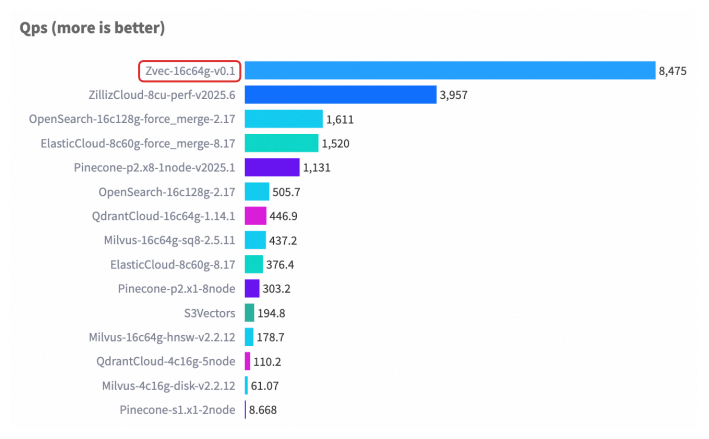 For detailed benchmark methodology, configurations, and complete results, please see our [Benchmarks documentation](https://zvec.org/en/docs/benchmarks/).
## 🤝 Join Our Community
For detailed benchmark methodology, configurations, and complete results, please see our [Benchmarks documentation](https://zvec.org/en/docs/benchmarks/).
## 🤝 Join Our Community
 |
|  | [](https://discord.gg/rKddFBBu9z) | [](
| [](https://discord.gg/rKddFBBu9z) | [](